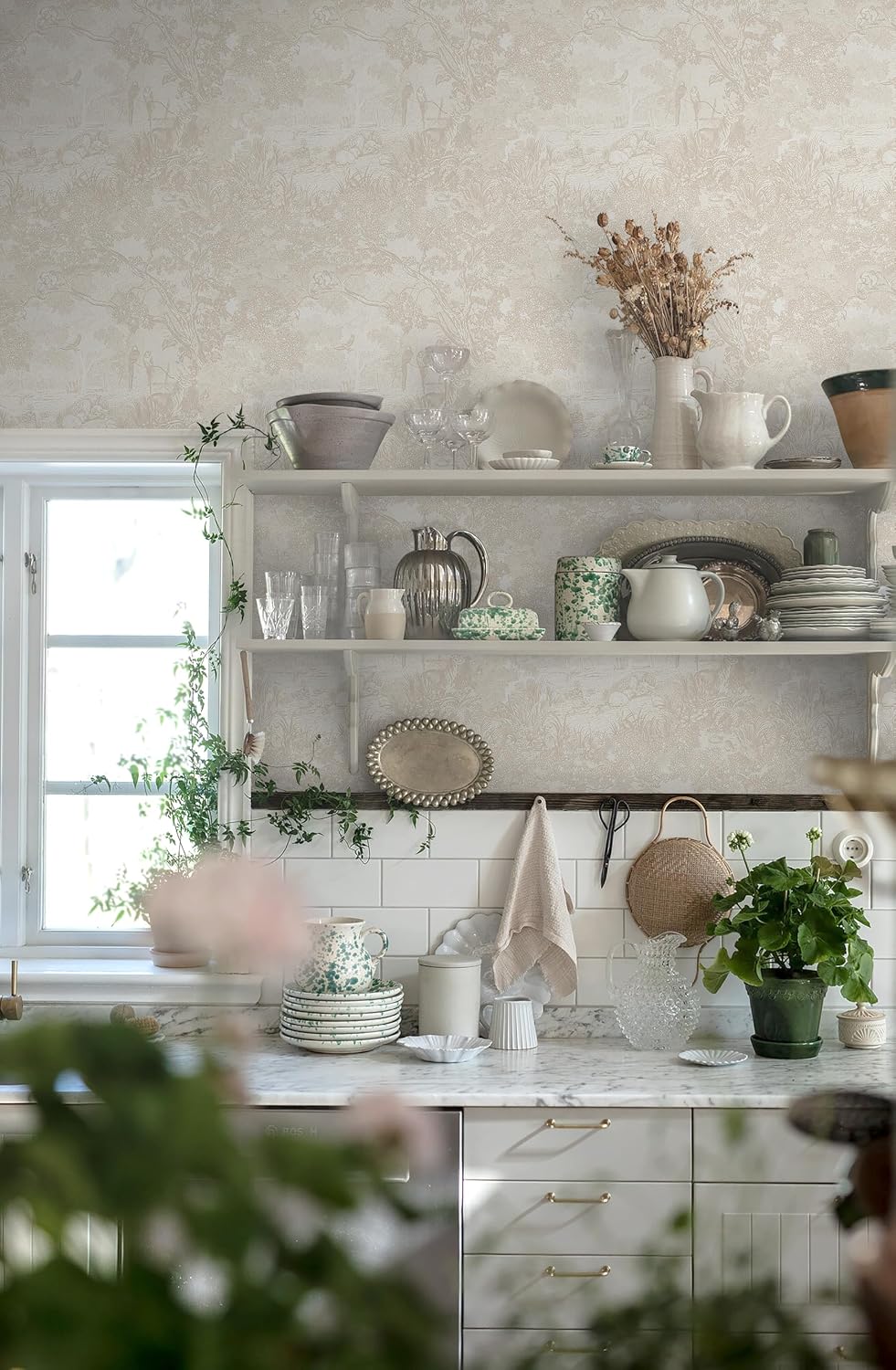
Vintage-style botanical and floral wallpapers have been climbing bedroom mood boards for a few years now, and the market has responded the way markets do: by flooding every price tier with options that look almost identical in a thumbnail. “Vintage boho floral” as a style category means loosely illustrated or painterly flowers — think blowsy roses, pressed-herbarium botanicals, or sun-faded William Morris–adjacent prints — layered with the warm, earthy palette and relaxed-maximalism feeling associated with bohemian decorating. That last phrase just means a design aesthetic that mixes global textiles, natural materials, and lived-in eclecticism rather than a polished, matched look. If you’re specifying a bedroom wallpaper right now and the shortlist keeps pulling you toward this genre, this guide is your decision framework. We’ll show you how to separate the patterns that will age beautifully from the ones that will read flat and cheap the moment they’re installed — and we’ll give you the math you need to buy right the first time.
| EDITOR'S PICK[VEELIKE Cottage Blue Toile Wall…](https://www.amazon.com/dp/B0DZNRW47F?tag=greenflower20-20) | Mid-tier[Laatse Vintage Wallpaper Peel a…](https://www.amazon.com/dp/B0CX1DCVPN?tag=greenflower20-20) | Budget pick[Nukofal Floral Wallpaper Peel a…](https://www.amazon.com/dp/B0D3W9DSNY?tag=greenflower20-20) | |
|---|---|---|---|
| Dimensions | 17.7''x354'' | 17.5'' x 393'' | 16.9"x118.1" |
| Material | — | Vinyl | — |
| Waterproof | — | ✓ | — |
| Pattern | Cottage Blue Toile | Black Floral | Dandelion |
| Style | Chinoiserie | Boho Botanical | Boho |
| Price | $45.99 | $38.99 | $9.99 |
| See on Amazon → | See on Amazon → | See on Amazon → |
Why the Category Is So Hard to Navigate Right Now
The honest answer is that vintage boho florals are easy to print. A watercolor-style botanical on a cream or aged-linen ground can be produced as a digital repeat by almost any print-on-demand vendor, which means Spoonflower and Anthropologie Home are sitting right beside Schumacher and Cole & Son in the same Google image search. The prices range from roughly $25 for a peel-and-stick accent roll to well over $400 a roll for a hand-printed or hand-painted luxury document. That range is real — it reflects actual differences in substrate (the material the pattern is printed or applied to — paper, non-woven, natural textile, or silk), ink permanence, colorway depth, and pattern construction. But those differences are nearly invisible at thumbnail size, which is the trap.
Dezeen’s 2025–2026 wallpaper market overview notes that the “maximalist botanical” category has seen the sharpest spike in catalog entries of any wallpaper style since 2022, making curation increasingly difficult even for experienced specifiers. House Beautiful’s 2025 trend roundup named aged, earthy florals a continuing force in bedroom design specifically — not a passing moment. That’s useful context: you’re not chasing a peak. But it also means the catalog clutter isn’t clearing anytime soon.
The Two Failure Modes to Avoid
Before the evaluation criteria, name the failure modes so you can recognize them mid-decision:
Failure Mode 1: Looks great in a swatch, reads muddy at scale. This happens when the print has low contrast between the motif and the ground, or when the repeat (the unit of pattern that tiles across the wall — think of it like a stamp that repeats end-to-end and top-to-bottom) is too small relative to the room’s ceiling height. A 9-inch repeat on a 9-foot wall produces roughly 12 tiled rows of pattern. If the motifs are delicate, it reads as texture. If the motifs are bold, it reads as chaos. Order a full-size sample — not a 4×4 chip — and tape it to the actual wall before committing.
Failure Mode 2: Color shift between rooms. Vintage boho palettes lean heavily on terracotta, sage, dusty rose, ochre, and aged white. These are warm, light-sensitive tones. A colorway that looks like “blush” under a showroom’s warm LED can read salmon-orange under a bedroom’s incandescent light and go greenish-grey under north-facing daylight. Wallpaper Direct’s bedroom buying guide explicitly flags this: they recommend requesting samples in the room’s actual lighting condition and living with them for at least 48 hours across morning and evening light before ordering. That’s the right protocol.
How to Evaluate a Pattern Before You Buy
Here’s the decision framework, broken into four criteria:
1. Repeat size versus wall height. Measure your wall height. Then look at the manufacturer’s listed repeat — it’s usually expressed in inches and labeled “pattern repeat” or “vertical repeat.” A repeat between 13 and 24 inches tends to work well for standard 8–9 foot bedroom ceilings: the motifs are large enough to read clearly but don’t tile too aggressively. Anything under 10 inches will likely read as an all-over texture rather than a floral. Anything over 27 inches on a standard ceiling will mean your installer is dropping significant material at the seams to align the pattern — and that waste is on your dime.
2. Substrate match for the room’s conditions. Bedrooms are relatively forgiving — lower humidity than bathrooms, less grease than kitchens — but if the room has an exterior wall that runs cold in winter, or if the homeowner is a warm sleeper who keeps a humidifier running, a paper-only substrate (traditional wallpaper with no synthetic backing) can absorb ambient moisture and bubble or peel over time. Non-woven substrates (a blend of natural and synthetic fibers, like a paper-fabric hybrid) are more dimensionally stable — they hold their shape when damp — and they’re the safer call for most bedrooms. Natural-fiber substrates like grasscloth or linen add genuine texture and age beautifully, but they’re harder to seam invisibly and can’t be wiped clean. Architectural Digest’s wallpaper installation guide notes that non-woven is now the industry-standard recommendation for DIY-adjacent installs precisely because it’s paste-the-wall rather than paste-the-paper, which gives you more working time and reduces the risk of over-soaking and tearing.
3. Colorway authenticity versus digital flatness. This is the hardest criterion to evaluate without a physical sample, but there are signals. Genuine vintage-feel florals have tonal variation within each motif — a petal that goes from deep dusty rose at the edge to near-white at the center. Flat digital prints often use a uniform fill color with a single antialiased edge. Ask the vendor: is this a surface-printed digital or a process that uses layered screens or hand-application? For the $80–$200 range (mid-tier brands like Graham & Brown or York Wallcoverings’ design-forward lines), digital printing is standard, but the better executions use higher-resolution files and more ink passes to approximate tonal depth. At $400+ per roll (Schumacher, Cole & Son, Elitis, Phillip Jeffries), you’re often buying screen-printed or hand-applied color with genuine tonal variation baked into the process.
4. Pattern scale relative to the room’s function. Bedrooms are where scale decisions read most personally — this is the room people wake up in and see first thing. Apartment Therapy’s wallpaper buyer’s guide recommends a useful calibration: if the wallpaper is going behind the bed (an accent wall, meaning one statement wall rather than all four), you can go larger in scale and bolder in repeat because the furniture partially frames and interrupts the pattern. If you’re papering all four walls, a medium-scale repeat with lower contrast between motif and ground will wear better over years than an oversized, high-contrast pattern that starts to feel demanding. Vintage boho florals on a deeper ground — charcoal, deep teal, or inky navy — can be stunning in a full-room installation and are currently having a significant moment, per House Beautiful’s 2025 roundup, but they require confident lighting design to avoid making the room feel smaller than it is.
The Math You Need Before You Order
Wallpaper is sold by the roll, but rolls are not standard. American single rolls are typically 20.5 inches wide and 16.5 feet long, yielding roughly 28 usable square feet. European double rolls (sold as one unit) are usually 20.5 inches wide and 33 feet long, yielding roughly 56 square feet. The discrepancy matters when you’re calculating quantities.
By the numbers:
- Standard bedroom accent wall (12 ft wide × 9 ft tall = 108 sq ft) → requires roughly 4–5 American single rolls before waste factor
- Add 15–20% for pattern-matching waste on repeats under 18 inches; add 20–30% for repeats over 18 inches
- Same wall in European double rolls: 2 double rolls covers it, with overage built in
- Dye lot rule: always order all rolls from the same dye lot (the production batch — rolls from different batches can have slight color variance that’s invisible until they’re side by side on the wall)
Architectural Digest’s installation guide and Wallpaper Direct both cite the 15–30% overage rule as non-negotiable. The number isn’t a markup — it’s pattern-matching math. Every time an installer cuts to align the repeat at a seam, the trimmed strip below the cut is waste unless it can be used as a short drop above a door or window. Irregular rooms with multiple windows and doors waste more than open walls.
Price Tier Decision Rules
If you’re working in the $25–$80 range (peel-and-stick options from Tempaper or Chasing Paper), the vintage boho floral category is genuinely viable for an accent wall behind a bed. The limitation is that peel-and-stick substrates have visible seams more readily than paste-up papers, and the pattern repeat options are narrower. Best for renters, children’s rooms, or low-commitment style testing.
If you’re in the $80–$200 per roll range, Graham & Brown’s botanical lines and York Wallcoverings’ Rifle Paper Co. collaborations consistently draw strong reviews from homeowners for tonal quality and ease of install — our pick for that budget if the vintage-floral direction is confirmed.
In the $150–$400 mid-premium range (Anthropologie Home, Burke Décor, Wallpaper Direct’s curated labels), the Spoonflower custom-print route is worth evaluating if the client has a specific colorway that the catalog market isn’t hitting. Lead times run 2–3 weeks, and you can order a single test print before committing.
At $400–$900+ per roll, the decision rule shifts: you’re not buying a pattern, you’re buying a document — a design with a provenance, often a numbered colorway with a production run. Cole & Son’s archival botanical prints and Schumacher’s maximalist florals are the references here. These installations require a professional hanger experienced with luxury substrates; amateur installation on a $600-per-roll paper is a very expensive regret.
The “If X, Then Y” Close
If the room has a clear accent wall behind the bed and the client wants a low-commitment, style-forward move: peel-and-stick in the $40–$80 range, prioritize a 13–18 inch repeat, order two extra panels as backup, and confirm the peel-and-stick is rated for the specific wall paint finish (matte paint holds better than eggshell for most brands).
If it’s a full four-wall bedroom installation with a defined budget under $200 per roll: non-woven substrate only, same dye lot, calculate waste at 20% minimum, and order a large physical sample before finalizing the colorway — per Wallpaper Direct’s protocol, 48 hours in the room’s actual light is the minimum evaluation window.
If the project is luxury-tier with a client who’s emotionally committed to a hand-printed document pattern: confirm lead times (8–16 weeks is common for Cole & Son or Schumacher special orders as of early 2026), get the installer involved before finalizing the pattern to confirm seam management, and build the overage order into the initial quote. Reordering a luxury dye lot mid-project is a problem that’s almost always avoidable and almost never cheap to fix.
The vintage boho floral category has genuine staying power — but staying power only translates to a good investment if the pattern, substrate, and scale are right for the specific room. The catalog clutter is real, and the shortcuts that look acceptable on a phone screen rarely survive the transition to an actual wall. Sample first. Always.