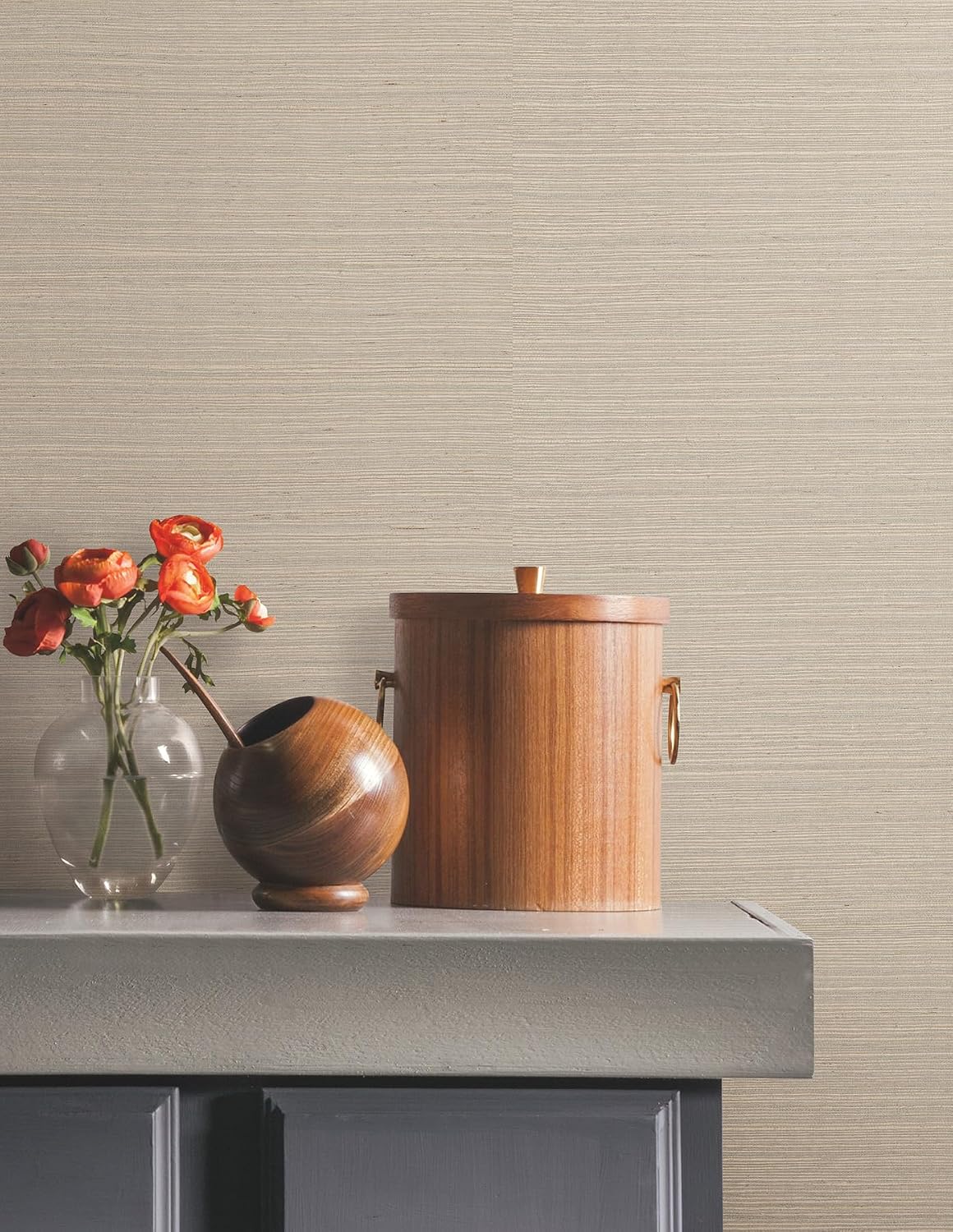
Grasscloth is a type of wall covering woven from natural plant fibers — jute, sisal, seagrass — layered onto a paper backing. Real grasscloth costs $80–$200+ per roll, requires professional installation, and cannot be wiped clean. “Faux grasscloth” (meaning manufactured to look like grasscloth, without the natural fiber) is a print-and-texture technique applied to a synthetic or paper-based sheet that you peel off a liner and press onto your wall. When that sheet also has a self-adhesive backing, you’re in peel-and-stick territory: no paste, no professional required, theoretically renter-safe. That’s the product category this guide covers. The catch is that “grasscloth look” and “textured peel-and-stick” are marketing phrases, not standardized descriptions — and what’s underneath that label determines whether your finished wall feels like a designer’s workroom or a craft-store backdrop. By the end of this article, you’ll be able to read a product listing, match the substrate type to your room’s conditions, and make a same-day sample order with confidence.
| EDITOR'S PICK[York Wallcoverings NZ0786 Grass…](https://www.amazon.com/dp/B00LP0OAW8?tag=greenflower20-20) | Mid-tier[York Wallcoverings NZ0780 Sea G…](https://www.amazon.com/dp/B00LP0VHN8?tag=greenflower20-20) | Budget pick[Haimin Grasscloth Textured Wall…](https://www.amazon.com/dp/B0C8D2BKM7?tag=greenflower20-20) | |
|---|---|---|---|
| Width | — | — | 24 in |
| Length | — | — | 393 in |
| Material | Grasscloth | Sea Grass | Vinyl |
| Adhesive | — | — | Peel and Stick |
| Style | Grasscloth | Grasscloth | Grasscloth Textured |
| Color | Black, Cream, Beige, Khaki, Tan | Pale Green, Cream, Beige, Tan, Brown | White |
| Price | $144.95 | $129.99 | $39.99 |
| See on Amazon → | See on Amazon → | See on Amazon → |
The Four Substrate Types Hiding Behind “Grasscloth Look”
When a listing says grasscloth-look peel-and-stick, it’s describing the visual and tactile goal — not the material achieving it. The substrate (meaning the actual material the wallpaper is made of and printed on) determines adhesion strength, texture depth, moisture tolerance, and whether removal leaves your wall intact. There are four substrate families you’ll encounter across the $25–$80 peel-and-stick tier, and they behave very differently.
1. Vinyl with Embossed Texture This is the most common substrate in the mass-market range. A thin PVC (vinyl) layer is heat-embossed — pressed with a patterned roller during manufacturing — to create a raised, woven-looking surface, then printed with the grasscloth colorway on top. The emboss is what you feel; the print is what you see. Published specs across brands like Tempaper and RoomMates typically show vinyl substrates in the 8–12 mil thickness range (a mil is one-thousandth of an inch — thicker generally means more durable and easier to handle without tearing). Apartment Therapy’s renter wallpaper guide notes that vinyl-backed options are the most forgiving during removal because the vinyl layer doesn’t absorb wall moisture the way paper does, which means the adhesive releases more cleanly. Tradeoff: vinyl reads slightly “plastic” in raking light (light coming from the side), and the emboss pattern is always perfectly regular — the tell that separates it from real woven material at close range.
2. Non-Woven Fabric Substrate with Printed Texture Non-woven is a blend of synthetic and natural fibers bonded together (think a sturdy, fabric-like sheet that doesn’t fray when cut). In this version, the grasscloth effect is entirely a print — no physical emboss — so texture is visual rather than tactile. Non-woven substrates breathe slightly better than vinyl, which matters in rooms with humidity fluctuation. The Spruce’s 2025 peel-and-stick roundup highlights non-woven options as having the most paint-like, dimensional print quality because the substrate surface accepts ink differently than vinyl. Tradeoff: the flat surface means zero physical texture. Run your hand across it and it feels like fabric paper, not weave. For rooms where you’re viewing the wall from across the space — a large dining room, a wide foyer — this reads beautifully. In a narrow hallway where people brush against the wall, the illusion collapses fast.
3. Woven-Texture Fabric Backing (True Textile Substrate) A small number of peel-and-stick products — mostly in the $60–$120 per roll range, from brands like Chasing Paper’s higher-end lines or artist collaborations on Spoonflower — use an actual woven or textured textile as the base material. The grasscloth pattern is printed onto a surface that already has genuine woven texture. This is as close as peel-and-stick gets to the real thing. Wallpaper Direct’s substrate guide describes textile-backed wallpapers as having superior dimensional quality precisely because the physical surface variation isn’t manufactured through embossing — it’s inherent in the material. Tradeoff: textile substrates are the most unforgiving during installation. They don’t slide and reposition as easily as vinyl, and they’re more sensitive to moisture at the seams. Measure twice; you get fewer second chances.
4. Paper-Backed “Grasscloth Print” (Lowest Tier) Some products marketed as grasscloth-look peel-and-stick are simply a paper substrate with a flat grasscloth-pattern print and a repositionable adhesive. No emboss, no textile weave. Architectural Digest’s 2025 grasscloth roundup explicitly distinguishes between “dimensional” and “flat-print” faux grasscloth options, noting that flat-print paper versions are best suited to low-traffic accent walls where the pattern is doing the design work, not the texture. These are fine as temporary installations or for low-commitment renters, but they’re the substrate most likely to show seam lines, absorb wall moisture and bubble, and tear during removal.
The Numbers You Need Before You Order
By the numbers — what to expect before your cart total:
- Standard peel-and-stick rolls: 20.5 in. wide × 18 ft. long (approx. 30.75 sq. ft. per roll)
- Add 15–20% overage for pattern repeat matching and edge trimming
- Typical grasscloth-look repeat: 13–21 inches vertically — confirm before calculating roll count
- Vinyl embossed substrates: 8–12 mil thickness; textile-backed: 12–18 mil (per published brand specs)
House Beautiful’s peel-and-stick buying guide reinforces the 15–20% overage rule for any patterned wallpaper, not just grasscloth. If your wall is 9 ft. tall and the pattern repeat is 18 inches, you’re losing meaningful length every time you need to align the repeat at the ceiling. Don’t let a tight roll count create visible mismatches at eye level.
Matching Substrate to Room Conditions — The Real Decision Frame
Here’s where practitioners tend to rush: they choose based on looks in the swatch photo, not based on what the room will do to the wallpaper over time. Substrate choice is an environmental match problem.
High-humidity rooms (bathrooms, laundry rooms, below-grade spaces): Vinyl embossed is the clear call. The non-porous surface resists moisture absorption, and the adhesive doesn’t fail the way it does on paper-backed options when humidity cycles up and down. Textile-backed and paper-backed substrates are both risky here — the fibers and paper core can absorb ambient humidity and cause the adhesive bond to weaken at seams before you’d expect it to. The Spruce’s review methodology notes that multiple reviewers report seam lifting in textile-backed products in rooms with poor ventilation.
Low-humidity, stable interior rooms (bedrooms, dining rooms, living rooms): All four substrate types can work here. This is where you let aesthetics drive the decision. If you want actual tactile texture — the kind that reads in person, not just in photos — you’re choosing between vinyl embossed and textile-backed. If you’re prioritizing print depth and visual richness over physical texture, non-woven fabric-backed is the move.
Rental properties with unknown paint history: Paint condition under the wallpaper is the invisible variable that wrecks otherwise solid installations. Peel-and-stick products of all substrate types can pull existing paint off the wall on removal if that paint wasn’t fully cured or was applied over a porous or inadequately primed surface. Apartment Therapy’s renter guide recommends testing adhesion in a low-visibility corner with a small sample before full installation — not as a formality, but because wall paint behavior varies building to building and even room to room. If the sample pulls paint when removed after 24 hours, no substrate choice saves you; the underlying wall needs prep (typically a coat of primer-sealer) before any peel-and-stick product goes up.
High-traffic corridors and hallways: Vinyl embossed wins again on durability, but the seam placement becomes critical. In narrow spaces, panel seams are visible and fingernails or bags catch on them. Textile-backed substrates with their higher mil thickness tend to hold seams more firmly and resist edge lifting better over time, per published brand guidance from mid-premium lines. Weigh the installation difficulty against the longevity payoff.
Reading the Product Listing Like a Practitioner
Most online listings for faux grasscloth peel-and-stick bury the substrate information or omit it entirely. Here’s the decode map:
Words that signal vinyl embossed: “embossed texture,” “3D effect,” “raised woven texture,” “vinyl wallpaper,” “wipe-clean surface.” These are reliable signals that you’re getting physical texture with a plastic backing.
Words that signal non-woven fabric: “fabric texture,” “fabric-feel,” “non-woven,” “breathable,” “matte finish wallpaper.” Expect visual-only texture, better print depth, no wipe-clean.
Words that signal textile-backed: “textile base,” “woven backing,” “fabric-backed,” “canvas texture.” These are the high-end peel-and-stick products — confirm mil thickness and installation guidance before ordering.
Words that signal paper-backed: “peel-and-stick wallpaper” with no texture claim, “repositionable wallpaper,” very low price-per-roll ($25–$35 range). Not necessarily bad, but don’t expect tactile texture.
The flag to watch for: listings that use “grasscloth texture” or “grasscloth look” as the only texture descriptor without naming a substrate. That’s almost always a flat-print paper product. If the listing doesn’t name a substrate, the sample order is non-negotiable — order a physical sample before committing to full-room quantities. No exceptions.
The If/Then Decision Rule
If your room has humidity variation, pets, kids, or high-traffic contact — vinyl embossed substrate, full stop. Accept the slight plastic sheen in exchange for performance and clean removal.
If you’re doing a low-traffic accent wall or a room where the view is from across the space and tactile feel doesn’t matter — non-woven fabric-backed gives you the richest print quality for the price and installs without the repositioning headaches of textile substrates.
If you want the closest approximation to real grasscloth — texture you can feel, depth you can see in raking light, results that photograph as the genuine article — textile-backed substrate in the $70–$120/roll range is the right call, with the understanding that installation is less forgiving and you should budget one extra roll for learning curve waste.
If budget is tight and the installation is explicitly temporary (staging, a rental you’re leaving in six months, a seasonal refresh) — paper-backed flat-print at $25–$45/roll is honest about what it is. Use it for what it does well; don’t expect it to do more.
The texture label on the listing is the beginning of the research, not the end of it. Get the sample. Read the substrate spec. Match the material to the room. That sequence is the difference between a wall you show off and one you quietly repaper six months later.